
I used to blog about museum work on my academic website. Since that page has gone away, I am using this space to repost some of my favorite bits. These posts were written in 2012-13.
Curatorial Authorship and/vs. Participatory Museums: What the What? | Originally posted December, 2012
On Tuesday, members of the Harvard Art Museums’ Graduate Student Task Force (from now on, HAM GST) met with Susan Dackerman, Carl A. Weyerhaeuser Curator of Prints, to talk about her practice. She conceptualized her role in a succinct and powerful way; as a curator, her job is to figure out “what to do with the knowledge embodied by individual objects” and deploy that knowledge in museum spaces, exhibitions, and publications. Curators infer meaning from materiality. Part of Susan’s job, of course, is to mount installations and exhibitions (both she and Rob Mawry drew a sharp distinction between these two). While a installation (often from the permanent collection) makes a statement, an exhibition is thesis-driven. That is, a curator’s task in designing an exhibition is to activate the meaning of art objects to visualize broader arguments. What’s more, Susan feels a responsibility to communicate artists’ decisions through exhibition design. Objects “work” differently in different contexts; works are active agents in the production of meaning because artists make choices. By carefully placing works in juxtaposition, Susan creates different meanings as a curator. Susan is a curatorial author, not only by choosing objects, but also by designing the spaces and textual environments in which the objects are encountered.
Museum spaces seem naturalized, but, as Susan pointed out to us, there are strategies that curators employ to make the “work” of museums invisible. The lack of awareness around curatorial authorship cuts off museum visitors from deep engagement with objects and spaces. Therefore, Susan is in the process of developing a training program to teach museum fellows how to read museum environments, how to look at them as authored spaces. This orientation toward authorship then feeds into the development exhibition-making skills; fellows will learn how to facilitate meaning-making for audiences through the lens of curatorial authorship.
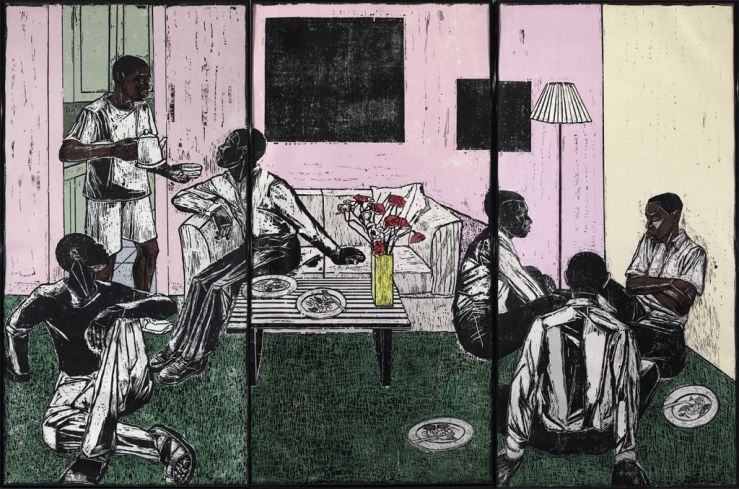
We looked at some of these choices-in-action in the Recent Acquisitions gallery of the Sackler. Susan was responsible for installing Kerry James Marshall’s Untitled, a monumental woodcut print depicting six African-American men in a quietly domestic setting reminiscent of seventeenth-century genre scenes. By interrogating Susan about her choices in front of her object in her gallery, it became really clear to us how an awareness of choice in museum spaces deepens the looking experience. Untitled is displayed on one wall (and a little bit); Susan explained how that “little bit” creates a sense of volumetric space in the piece. Corinne Zimmermann, the Senior Educator at HAM, explained how many of the installation choices “work” when she gives tours; after climbing up the stairs, viewers are confronted at first with a slice of a panoramic city scene. From the other entranceway, the central figures are framed by the doorway before visitors enter the space. Sarah Grandin, a grad student in the history of art and architecture, pointed out that the hanging of this artwork (alone in an otherwise empty gallery) was reminiscent of controversial exhibitions in the Salon. Ethan Lasser, Margaret S. Winthrop Associate Curator of American Art, interrogated Susan about the burden of interpretation: Who is responsible for making curatorial authorship visible? Should transparency be built into the design of the exhibition, or should audiences be educated enough to see through the “invisibility cloak” of curatorial practice?
Needless to say, when I saw Nina Simon’s post about “Work In Progress” at the Santa Cruz MAH, I was immediately intrigued with this idea of transforming a space from “a museum of products to a museum of process.” Is there a difference between curatorial authorship and curatorial process? Our orientation toward audience meaning-making is different at the HAM than at the MAH; curators like Susan are interested in communicating “what I want you to learn,” while Nina Simon’s perpetual beta approach sees venues like museums as content platforms rather than content providers.
Here is my big question: If we are interested in making curatorial authorship transparent, and if active learning in art museums makes experiences “sticky” and meaningful, why not jump on the participatory museum bandwagon and let audiences do the curating? Maybe that’s not right for our university museum. It’s a good sign, however, that HAM is having these conversations. And I am so, so lucky to be a part of them.
 mindful museums