Hands on History: Messaging “Touch” at California’s History Museums

This paper was written for an introductory research methods class at UC Berkeley’s Graduate School of Education.

Contemporary museums are more than mausoleums conserving the material culture of late, great empires for receptive, elite publics. Since the 1990s, museums have increasingly articulated their public value in terms of education and community wellbeing (Hooper-Greenhill, 1999). Embracing insights from sociocultural theory, sociology, neuroscience, and psychology, museums have begun to recognize themselves as multimodal, sensory, and affective spaces (Levent & Pascual-Leone, 2014) and have shifted their communication, programmatic, and educational strategies accordingly.

Citing the United Way of America’s adoption of new evaluation practices in 1995 and the passage of the Government Performance and Results Act in 1993, Stephen Weil argues that the structural changes to non-profit and government funding in the United States has fundamentally transformed the work of museums. Whereas museums used to be internally-facing institutions, focusing almost exclusively on the accumulation, preservation, and interpretation of their collections on behalf of the public, museums are now compelled by funding requirements to demonstrate their public value more broadly (Weil, 1999, 2000). This trend was compounded by the founding of the federal Institute of Museum and Library Services and the Museum Assessment Program of the American Association of Museums (AAM)[1]. The requirement for museums to produce outcome-based assessments and impact statements have thus shifted priorities in policy and practice toward effectiveness and public accountability.

Museum education has been caught up in these institutional shifts. The 1992 report Excellence and Equity: Education and the Public Dimension of Museums by the AAM summarized these changes and asserted the central role of education in museum practice. The report offered a new definition of museums  “as educational institutions that carry out their public service in the spirit of excellence and equity” and argued that “[m]useum missions should state unequivocally that an educa­tional purpose is imbedded in every muse­um activity” (American Association of Museums & Hirzy, 2008, p. 16). Among other functions deemed “essential” to educational practice, the report cites “human interaction and interaction with objects and ideas” and “direct encounters with objects” as key contributions that museums make to public service and scholarship (American Association of Museums & Hirzy, 2008, p. 13).

Object-handling programs in museums thus align with the recommendations set forth in Excellence and Equity. Indeed, substantial research affirms the value of hands-on learning for conceptual change. Embodied cognition recognizes the entanglement of experience, perception, and thinking, in which cognitive structures both emerge from sensorimotor activities and guide perception (Varela et al., 1991). By recruiting perceptual-motor systems through movement and interaction, hands-on learning coordinates the body with symbolic representations (Abrahamson & Sánchez-García, 2016; Schwartz et al., 2016). In museums, hands-on programs designed to enhance conceptual learning in the social sciences may look like artifact-handling sessions for the general public or touch-tours for blind or low-vision visitors. Outside of structured programs designed to explicitly recruit touch as a learning modality, art and objects in museums nevertheless excite memory and emotion through their (imagined) tactility and sensory qualities. The presence of the artists’ hand in a swipe of paint, marks on artifacts indicating their original use or find context, a finger in a portrait stroking lace or resting on a shiny globe: all invite and activate sensory experience (Freedberg & Gallese, 2007). Since the “sensory turn” in cultural studies (Howes, 2006, 2014; Howes & Classen, 2014), research about and programming for embodied experiences in museums have become increasingly popular (Faron & Banda, 2014; Kai-Kee et al., 2020).

The discussion about touch in Western museums is nothing new. From the royal Wunderkammern of the 16th century to the founding of imperial, encyclopedic museums in the 17th and 18th centuries, touch was considered a key modality for empirical investigation, aesthetic appreciation, and religious veneration. In the 19th century, changes in scientific practice and theory—as well as progressive programs of public education—changed the sensory regime of Western culture (Classen, 2012; Leahy, 2012). Touch in the museum was rendered taboo by the 20th century; a cascade of new socio-sensory ideologies, exhibition display technologies, and techniques of bodily management have elevated sight as the primary sense in museum experience (Classen, 2005).

Despite the increasing regulation of touch in museums since the 19th century, touch—both sanctioned and unsanctioned—has never been entirely absent from the museum visitor experience. In response to David Howes’s 2014 special issue of Senses & Society about the rehabilitation of “sensory museology” (Howes, 2014), Fiona Candlin conducted a preliminary study of “illicit” or “unauthorized” touch at the British Museum. Her interviews with museum guards and visitors highlighted the various reasons why someone might reach out to stroke a stele or sarcophagus. Some visitors were confused about the rules, while others used touch empirically to confirm whether objects were real or replicas. In the majority of responses, “visitors talked about touch as a way of trying to make historical distance comprehensible and in so doing to grasp their own place whether that is ‘as a speck in history’ or as part of ongoing, shared embodied experience” (Candlin, 2017, p. 258). Throughout the changing tides of sensory ideology, museums have continued to be places of learning and social interaction, and sites at which to acquire and convey cultural authority.

As part of a broader research program exploring the value of object-based learning with historical artifacts in heritage contexts (Chatterjee, 2008), this preliminary study uses summative content analysis to understand the context and use of the word “touch” on museum websites. Balancing conservation and education, museums must navigate the rocky terrain between authorized and unauthorized touch: between hands-on, active learning with sanctioned artifacts under organized or programmatic conditions and illicit, incidental, or curious touch. This tension is reflected in the explicit contexts and latent attitudes toward “touch” on museums’ websites. At the site of their most accessible, public presence, museums reveal conflicting approaches to touch: elevating it as a primary learning modality, condemning it for its destructive force, or celebrating it as a mode of connection and reminiscence.

Methods

All American Alliance of Museums-accredited history museums in California (n=106) were sampled for this study, based on the membership database accessible through the AAM website. With their core missions to collect, conserve, and interpret historical material culture for diverse publics, history museums fit the broader research agenda to study object-based learning in heritage contexts. Furthermore, eight percent of AAM-accredited history museums are located within California and represent a range of historical subjects, museum sizes, and visitor populations. Future iterations of this study will include data from other types of collections-oriented heritage museums, including ethnically- and tribally-specific museums, natural history museums, general or multi-disciplinary museums, and anthropology museums (see Table 1).

ZSilverman_Final_Research_Paper

The Google site:search function [“touch site:example.com”] was used to identify all uses of the word “touch” on each institution’s website. After an initial trial, “hands” was not used as an additional search term, as results that returned for “hands-on” were not specific to artifact or collections object-handling. Excluded uses of “touch” include:

  • Children’s “hands-on” galleries, except where museums specifically call for touch as a learning modality
  • Idiomatic mentions of touch (“Get in touch,” “he touched the hearts of many,” “this lectures touches upon”)
  • Touching animals or living collections exclusively
  • Touch screens
  • COVID-19-related touch procedures

After excluding the cases listed above, 54 unique uses of the word “touch” across 27 history museums in California were identified for inclusion in the study. Texts featuring the keyword “touch,” direct links, and additional metadata were scraped and added to the study database; PDFs were linked via Google Drive. Additional attribute codes––text context, presence of images, and other details––were then added. The data were read over multiple times by the author to gain an overall sense of content and themes. Initial codes were then developed and included a mixture of structure, description, in vivo, and emotion codes. Magnitude codes were added to capture first impressions of the valence of texts, i.e.: whether “touch” was considered in a positive, neutral, or negative light (Saldaña, 2015).

Results

Texts were analyzed using summative qualitative content analysis. Content analysis is a research technique that systematically employs codes to identify and analyze certain words, themes, and concepts within a given text, leading to a full characterization of the “manifest content of communication” (Berelson, 1952). Summative qualitative content analysis includes both deductive and inductive coding techniques to provide basic insight into the use of keywords in context (Hsieh & Shannon, 2005).[2]

Overall, touch is considered in a positive light on museum websites. Out of 54 texts identified for inclusion in this study, 42 were coded with positive valence (see Table 2 for text examples). Webpages and newsletters designed to market new exhibitions or programs, reflect on past programs, or announce access schemes are overwhelming positive about the potential for touch to deepen visitors’ social and educational experiences. Indeed, a predominant theme identified in the initial round of coding concerns the connection between past and present through sensory engagement. Phrases like “we explained the artifacts at the table with enthusiasm in order to make the history more interesting and exciting for the public,” “students will touch and use artifacts to develop an understanding of past desert cultures and present desert uses,” and “we who share their piece of history, will gently touch a wingtip before climbing aboard, and always recall with reverence, those who came before us” speak to the power of touch in the development of historical empathy, imagination, and perspective-taking (Nilsen, 2016).

ZSilverman_Final_Research_Paper 2

A second theme emerging from the initial round of coding concerns touch as one element of a multisensory learning experience. On a webpage advertising Girl Scout badge programs to group leaders, one local history museum describes their offerings for Brownies this way: “Look, listen, smell, taste, and touch. See how Historians use all of their senses in uncovering hidden secrets of the past. Select from several possible options for stimulating all five senses.” Elsewhere, an Asian American cultural center invites families to “Hear, touch, and play! A hands-on taiko experience for the whole family…” Here, touch is framed in the language of exploration and whole-body engagement, one modality (among many) through which to experience history and culture.

In contrast to the positive framing of touch in these contexts, visitor policies trend toward the negative: “”Guests must NOT touch the glass and must stay at least one foot away from objects. They must NOT touch exhibits, walls, or statues.” “”No sitting on or touching the Adobe furniture.” “”Refrain from touching the exhibitions, stantions, and ropes.” Notably, all of the texts labeled with negative valence in this study (n=9) come from PDFs that are not easily accessible from the homepage of the museum. That is, one must go looking for the visitor policy and then download additional material to find these negative statements about touch. Additionally, two of these negatively-framed no-touch policies are embedded in materials for K-12 audiences, while three instances of no-touch policies directed at K-12 audiences are decidedly positive in their framing. For example:

We hope that your visit will be a fun and enjoyable experience. To ensure that all guests to the museum on the day of your expedition have a similar experience, please encourage children not to touch the exhibits, displays or statues and to speak and walk softly as if they were in a library. Please ensure that students do not climb on the statues or columns…This is not only for the sake of the statues and columns, but for the safety of the students.

Indeed, seven no-touch policies for K-12 and public audiences are framed in this way: the policy begins with a polite opening (“please”), ample justification is offered, and visitors are encouraged to use other learning modalities to supplement their active learning process (“It is usually best to stay at least arm’s length from any displayed object and ‘point’ with a flat hand”). It is in these visitor policies––hidden under layers of webpages––that the tension between productive and destructive touch is clearest.

Conclusions

Do not touch Controls and Switches–this is a live ship and you could hurt yourself or others

Walk up and touch the fighters, bombers, and helicopters that took naval aviation into the jet age

This pair of texts––each from a different naval ship museum––speaks to this unique moment in museological practice. Variations in the valence of messaging on the websites of California’s history museums reflect the contested status of touch as an important aspect of multisensory learning on the one hand and as a threat to the conservation of valuable material culture on the other. As museums begin to re-open after COVID-19-related closures, visitor policies and interactive programming will undergo massive changes (Trusty, 2020). Almost 30 years after the publication of Excellence and Equity, museum education still faces a crisis of evaluation; it is difficult for practitioners to articulate what change (if any) museum education can effect (Garcia, 2012). In the midst of these ongoing challenges, leaders in the field are already declaring a “code red” moment for museum education (Hogarth, 2020). Despite the popularity and efficacy of hands-on programs, it is unclear whether there will be any education staff left to facilitate them.[3] Additionally, increased vigilance about touch-related visitor policies in a post-COVID-19 world will likely lead to differential monitoring and enforcement. Maurice Berger, art critic and curator who died of COVID-19-related complications in March, posed the question in 1992: “Are Art Museums Racist?” (Berger, 2020). Thirty years later, the answer has not changed. Despite the overwhelmingly positive appraisal of touch on the websites of California’s history museums, the field will need to be ever more aware of and responsive to institutional legacies of racism and classism as they manifest in managerial practices, visitor policies, and enforcement behavior once the doors are opened again.

Limitations and reflection on methods: Some museum websites may be poor indicators of conditions “on the ground” as relating to touch-based programs; the presence of archived newsletters in the study database collected through the Google site:search function indicate that this data collection method may skew results toward older programs and communications that no longer represent current museum practice. The inclusion of additional categories of collections-based historical museums (for example, Tribal museums) and Second Cycle coding methods (Berger, 2020) would help to achieve saturation, support the validity of the findings, and identify possible sites for targeted interviews. Following the model set forth in Candlin’s article about illicit touch, an ethnographic approach to studying variations of touch at one or more institutions could lead to rich findings.

It became clear to me that one round of initial coding using Google sheets was not sufficient to make definitive claims about a phenomenon, and I am not confident in the magnitude coding scheme to determine the valence of texts. After conducting this study, I see the value of having a team of code reviewers, more systematic approaches to coding (including axial coding), and coding software like MAXQDA. I look forward to honing my coding skills in future qualitative research courses.

[1] The name of the association was changed to the American Alliance of Museums in 2012 to “better reflect the 106-year old organization’s mission of unifying the diverse museum field, championing its cause and nurturing excellence among all of America’s museums” (Press Release: The Association Is Now the Alliance, 2012).

[2] Although the data are not anonymized, quotes from museum websites in the remainder of the report will not be cited (as practice for future research).

[3] For instance, the Museum of Modern Art in New York City told educators “it will be months, if not years, before we anticipate returning to budget and operations levels to require educator services” (Di Liscia, 2020).


References

Abrahamson, D., & Sánchez-García, R. (2016). Learning is moving in new ways: The ecological dynamics of mathematics education. Journal of the Learning Sciences, 25(2), 203–239. https://doi.org/10.1080/10508406.2016.1143370

American Association of Museums, & Hirzy, E. C. (2008). Excellence and equity: Education and the public dimension of museums (2nd reprint). American Association of Museums.

Berelson, B. (1952). Content analysis in communication research. Free Press.

Berger, M. (2020, March 31). Are art museums racist? Art in America. https://www.artnews.com/art-in-america/features/maurice-berger-are-art-museums-racist-1202682524/

Candlin, F. (2017). Rehabilitating unauthorised touch or why museum visitors touch the exhibits. The Senses and Society, 12(3), 251–266. https://doi.org/10.1080/17458927.2017.1367485

Chatterjee, H. (Ed.). (2008). Touch in museums: Policy and practice in object handling. Berg.

Classen, C. (2005). Touch in the museum. In C. Classen (Ed.), The book of touch (pp. 275–309). Berg.

Classen, C. (2012). The deepest sense: A cultural history of touch. University of Illinois Press.

Di Liscia, V. (2020, April 3). MoMA terminates all museum educator contracts. Hyperallergic. https://hyperallergic.com/551571/moma-educator-contracts/

Faron, R., & Banda, J. (2014). Exhibition carts: Intentionally designed spaces on the move. Exhibitionist, 20–25.

Freedberg, D., & Gallese, V. (2007). Motion, emotion and empathy in esthetic experience. Trends in Cognitive Sciences, 11(5), 197–203. https://doi.org/10.1016/j.tics.2007.02.003

Garcia, B. (2012). What we do best: Making the case for the museum learning in its own right. Journal of Museum Education, 37(2), 47–55. https://doi.org/10.1080/10598650.2012.11510730

Hogarth, B. (2020, May 6). Code red for the museum education profession. Art Museum Teaching. https://artmuseumteaching.com/2020/05/06/code-red/

Hooper-Greenhill, E. (Ed.). (1999). The educational role of the museum (2nd ed). Routledge.

Howes, D. (2006). Charting the sensorial revolution. The Senses and Society, 1(1), 113–128. https://doi.org/10.2752/174589206778055673

Howes, D. (2014). Introduction to sensory museology. The Senses and Society, 9(3), 259–267. https://doi.org/10.2752/174589314X14023847039917

Howes, D., & Classen, C. (2014). Ways of sensing: Understanding the senses in society. Routledge.

Hsieh, H.-F., & Shannon, S. E. (2005). Three approaches to qualitative content analysis. Qualitative Health Research, 15(9), 1277–1288. https://doi.org/10.1177/1049732305276687

Kai-Kee, E., Latina, L., & Sadoyan, L. (2020). Activity-based teaching in the art museum: Movement, embodiment, emotion. Getty Publications.

Leahy, H. R. (2012). Museum bodies: The politics and practices of visiting and viewing. Ashgate.

Levent, N., & Pascual-Leone, A. (Eds.). (2014). The multisensory museum: Cross-disciplinary perspectives on touch, sound, smell, memory, and space. Rowman & Littlefield.

Nilsen, A. P. (2016). Navigating windows into past human minds: A framework of shifting selves in Historical Perspective Taking. Journal of the Learning Sciences, 25(3), 372–410. https://doi.org/10.1080/10508406.2016.1160830

Press release: The Association is now the Alliance. (2012, September 5). American Alliance of Museums. http://ww2.aam-us.org/about-us/media-room/2012/the-association-is-now-the-alliance

Saldaña, J. (2015). The coding manual for qualitative researchers (3rd ed.). SAGE Publications.

Schwartz, D. L., Tsang, J. M., & Blair, K. P. (2016). The ABCs of how we learn: 26 scientifically proven approaches, how they work, and when to use them. W. W. Norton.

Trusty, R. (2020, May 8). What will become of interactive art when museums reopen? American Alliance of Museums. https://www.aam-us.org/2020/05/08/what-will-become-of-interactive-art-when-museums-reopen/

Varela, F. J., Thompson, E., & Rosch, E. (1991). The embodied mind: Cognitive science and human experience. MIT Press.

Weil, S. E. (1999). From being about something to being for somebody: The ongoing transformation of the American museum. Daedalus, 128(3), 229–258.

Weil, S. E. (2000). Transformed from a cemetery of bric-a-brac… Perspectives on Outcome Based Evaluation for Libraries and Museums (Institute of Museum and Library Services), 10–33.
Hatano & Inagaki (1986)

Hatano, G., & Inagaki, K. (1986). Two courses of expertise. In H.W. Stevenson, H. Azuma, & K. Hakuta (Eds.), Child development and education in Japan: A series of books in psychology (pp. 262-272). New York NY: W.H. Freeman.

Hatano and Inagaki’s chapter unpacks the processes of achieving two kinds of expertise: adaptive and routine. Both require the accumulation of experience and consist of using prior knowledge to assimilate/accommodate domain-specific problems under the supervision of more capable experts. Whereas routine experts demonstrate exceptional speed, accuracy, and automation of skills in particular contexts but lack the flexibility to extend their skills to new domains, adaptive experts use conceptual knowledge to invest procedures with meaning, make predictions about unfamiliar situations, and invent new strategies.

The authors begin by contrasting procedural knowledge with conceptual knowledge to understand how novices become adaptive experts. Procedural knowledge involves the rules, executive strategies, and skills that people learn through daily life; indeed, procedural knowledge can lead to effective behavior even without depth of understanding. In considering the development of expertise, Hatano and Inagaki here accept two Piagetian assumptions: that humans have an intrinsic motivation for understanding, and that knowledge is acquired through reflexive abstraction (reorganizing prior knowledge). Hatano and Inagaki argue that the dissatisfaction with procedural competence drives people’s desire to find meaning, explain why things work, judge the appropriateness of various options, and modify skills according to changes in the environment. [It is noteworthy that this drive to understand is not age-dependent: according to the authors, what distinguishes adults and children as learners is the depth of domain knowledge they have.] Although inquiry can precipitate the development of conceptual knowledge, individuals also need data (empirical knowledge) and models (preconceptual knowledge) to build a more complete picture.

In teasing out the distinction between adaptive and routine expertise, the authors acknowledge that routine expertise can lead to some “generalized consequences” like the development of related procedural skills (in the same domain), increased efficiency, and the production of new mental models which support the completion of tasks (physical abacus → mental abacus). They then identify three key factors that encourage individuals to engage in the kinds of experimentation that lead to adaptive expertise. First, randomness inherent to specific problem-spaces requires people to modify their approaches after observing variable outcomes. Second, stakes matter: people are more willing to engage in active and playful experimentation when the results are not rewarded or evaluated. Third, group-cultures that value experimentation over efficiency demonstrate increased levels of adaptive expertise. Hatano and Inagaki end here with an implicit critique of assessment culture in schools (inhibiting playful experimentation) and an explicit call to compare children from efficiency-oriented cultures (Japan) to understanding-oriented cultures regarding flexibility and adaptability.

Bransford, Brown, & Cocking (2000)

Bransford, J. D., Brown, A. L., & Cocking, R. R. (2000). From speculation to science.In How People Learn: Brain, Mind, Experience, and School, Expanded Edition (pp. 3–27). Washington DC: National Academies Press.

This introductory chapter to Bransford, Brown, and Cocking’s second edition of their National Research Council report summarizes the impacts of the “revolution in the study of the mind” since the 1970s on theories of learning and highlights implications for educational practice in formal and informal settings across the lifespan. The authors’ key claim is that, by following teaching strategies aligned with the emerging science of learning, educators will make it possible for more students to develop a deeper understanding of traditional disciplines.  Driven by the growth of interdisciplinary inquiries, new collaborations between researchers and educators, and advances in the tools of cognitive science and related disciplines, a new theory of learning has emerged that challenges standard approaches to curriculum design, teaching, assessment, and policy.

The chapter begins with a short historiography of the learning sciences, from Wilhelm Wundt’s analysis of human consciousness through behaviorism (both radical and moderate) to the emergence of cognitive science in the 1950s. This new field has made it possible for scientists to test theories about thinking and learning through rigorous qualitative and experimental research methodologies with attention to the social and cultural contexts of learning. The authors then turn to some of the hallmarks of the new science of learning and their implications for teaching:

  • Understanding (juxtaposed with but not alienated from “facts”) is defined as “usable knowledge” that is connected to and organized around concepts, conditionalized to context, and transferable across disciplines. Students must have a solid base of factual information in order to build understanding; teachers must have a disciplinary expertise themselves,  a lived experience of “the process of coming to see” (John Armstrong) in that discipline, a commitment to depth over breadth, and assessments that are aligned with evidence of deep understanding.
  • The authors identify the significance of prior knowledge in the process of knowing, wherein goal-directed learners bring pre-existing knowledge, skills, beliefs, and concepts into new environments. These prior conditions determine how new information is perceived and processed by learners. Students bring both predictable and idiosyncratic preconceptions about the world to the classroom; teachers must actively inquire about students’ thinking, be aware of common preconceptions and, through formative assessment, make thinking visible.
  • Active learning is defined as the process of assessing understanding and acquiring additional information and skills. Metacognition, or the ability to predict performance and monitor current understanding, is supported by teaching practices that encourage sense-making, self-assessment, and reflection, leading to greater instances of transfer. Inquiry-based metacognition skills must be modeled, contextualized, and taught across disciplines.

Finally, the authors turn toward the implications of these findings for the design of classroom environments. These areas of cultivation include: making schools “learner-centered” (aware of preconceptions, sensitive to students’ cultural contexts and theories of intelligence), creating “knowledge-centered” classrooms that emphasize the what (information) along with the why (understanding) and the how-do-we-know-when-we-get-there (mastery), creating formative assessments that accurately monitor understanding, and taking a “community-centered” approach to norms and culture in order to cultivate excitement. They conclude with a nod toward adult learning, suggesting that teacher professional development programs could benefit from a redesign with learning sciences in mind.

Family Learning hacks from the IKEA catalog

Below are quotations from the 2017 IKEA catalog, followed by some reflections on my practice as a family educator in museums. #deadserious

Imperfect is perfect enough: The “perfect” dinner party doesn’t exist…Friends, family and neighbors are all invited. Push together the tables, put a handful of flatware in a jar and grab any seat you can find. This is a family-style dinner where it’s ok to spill–and put your elbows on the table. (12)

  • Family programs are messy and informal. 
  • Family programs might not meet expectations. As educators, we can let go of our picture of what a “perfect” family program looks like. Also, we can communicate to participants that the outcome might not match their expectations…and that that’s ok.
  • “Family” is a big tent: everyone is invited. When everyone is invited, things get messy and sometimes elbows can get in the way. That’s all part of it. That’s the work and the joy.

The no-rules family dinner: These days, the family dinner is whatever – and wherever – we want it to be. But there’s one thing we can all agree on – that being together is what we care about. A comfy dining spot we never want to leave is where we tell our stories, create memories and throw out the old rules. So eat at the table. Eat under the table. Eat on the sofa. Or eat in a tent. As long as it’s together. (14)

Share a meal – anywhere: …The days of “have to” are over. Go ahead and eat around a coffee table. Sit on the sofa. Or on the floor. Because it doesn’t really matter where we eat – just that we get to be together. (24)

Chaos-free company: The living room is a busy place. It’s a snug spot for relaxing, a hub for socializing as a family, and the room of choice for everyone to do their own thing…Comfortable yet clever seating for every body in the house, and smart storage for tidying up diverse interests creates space for what truly matters – getting all those bodies together. (88)

  • Family learning spaces should be flexible enough to accommodate different types of learners.
  • Accessibility is not a luxury, an afterthought, or a “nice thing to do”: it is necessary to get people together, to create what truly matters.
  • Comfort leads to sharing, storytelling, risk-taking, and memory-making.
  • Above all, families value togetherness.

The passion project table: The dining table has long been used for a lot more than just eating. So we’re breaking with tradition and renaming this one the “project table” – a hub of the home where everyone gathers to play and work (a little). Here are all of the books, supplies and good lighting needed to plan a far away trip, do some homework or make something beautiful. It’s a convenient, cozy spot to get creative. (18)

  • Different activities can take place in the same space, provided the workstation is flexible and convenient. Activities can serve different audiences in the same space at the same time.
  • Having materials and inspiration close at hand promotes creativity.
  • Adults can model work and play for children in the same space.
  • Understanding the reality of how spaces are being used helps us meet the needs of current visitors and strategically plan for the future.
  • A well-designed space can encourage creativity by allowing users to alternate between learning modalities (and signalling that such shifts are desirable).

The dream dining area: The dining area is where we gather – to share a meal, tell stories and make grand plans. It’s important to get it just the way you want it because the atmosphere helps create these moments – big and small… (21)

  • The very act of gathering is generative: together time can lead to storytelling, ideation, and planning.
  • Design matters: atmosphere creates opportunities to deepen connections and increase feelings of affiliation.

Stress-free socializing: …It’s the no-expectations dinner party, where it’s ok to put your guests to work. Everyone cooks together in an atmosphere that’s casual and cozy – a pressure-less affair that allows you to be the guest too. (36)

  • Invite families to become co-creators: solicit input and receive it joyfully, authentically, and with gratitude. Relax the hierarchy of designer/facilitator and participant.
  • Museum staff are people, too. Programs that allow facilitators to relax and enjoy the experience make for happier times for everyone.

Cooking is the best part of the meal: In this family kitchen, there are never too many cooks. All of the counter space can be found on the big island, a place to stand elbow-to-elbow while each peels, chops and dices up their part of the meal…It ensures that everyone can be involved in a family ritual that brings us closer – and creates some messy memories. (46)

  • Activities designed for different bodies, ages, and interests can happen in parallel while moving toward a shared goal.
  • Rituals promote feelings of security and confidence.
  • The mundane is extraordinary and can be an opportunity for families to make memories together.

Climbing and cuddling: Precious moments with our kids are the memories that stay with us. But in the everyday, it can be hard to find time for those moments. So we came up with an unconventional fix. We brought the bunk bed out of the kids’ room and put it in the living room – giving it a refined and mature aesthetic. It’s part jungle gym and part cozy sofa, a piece that lets kids be kids and adults be adults – together. (90)

Tidy toys, happy parents: The living room is the together room – a place for parents to unwind and kids to play. But in many homes, playtime is when the toy box explodes with books, blocks and stuffed bears. Handsome toy storage can be hung low or placed on the floor, making it easier for kids to reach. This way clean-up can happen as a family – a moment of togetherness that also restores a bit of sanity. (116)

  • A well-designed space opens opportunities for togetherness that otherwise would pass us by.
  • Spaces can be structured to encourage us to be our best selves, help each other, and do good. Anyone of any age can contribute to “shalom in the home.”
  • Aesthetics are important for everyone. Children’s materials and storage can be pleasing to kids and grown-ups alike, encouraging everyone to take care of communal spaces.

Small acts, big change: Most of us are aware of the impact our daily lives can have on the planet, but “being sustainable” feels like a big job. The thing we often forget, though, is that we’re not supposed to do it alone. The key is finding small ways to do our part. Because when we add up these small acts, that’s when the big change really happens. (61)

Why good design is democratic: …Democratic design helps us raise the bar for making better products for more people – better because they’re developed with an understanding that people want things that work and make life easier (function), that are beautiful (form), demand value for money (quality), care about the planet (sustainability), and are affordable (low price). (171)

I mean, that’s it, right?

Dr. Mimi Ito: Teens in the Digital Age

A few months ago, I was invited to attend a new lecture series called Selah, a program of the Janet & Jake Farber Teen Experiential Educator Network. Selah brings teen educators high-quality speakers, discussing tangible, needs-reflective topics about the field of Jewish Experiential Education.  The goal is to grow the community and encourage greater knowledge-sharing and relationship-building between the teen educators across the Los Angeles geographic and Jewish landscapes.

The February lecture was given by Dr. Mizuko Ito, who spoke about Teens in the Digital Age. Dr. Ito is a cultural anthropologist specializing in learning and new media, particularly among young people in Japan and the US. Her current research focuses on how to support socially connected learning experiences for young people. With the support of the MacArthur Foundation, she helped launch the Connected Learning Alliance, dedicated to realizing a world where all young people have equitable access to learning opportunities that are social, participatory, driven by personal needs and interests, and oriented toward educational, civic and economic opportunity. Additionally, she chaired a MacArthur Foundation research network on Connected Learning with an interdisciplinary group of researchers seeking to study and design for connected learning environments.


Here are some of the questions and puzzles that Dr. Ito raised in her lecture at Selah:

  • What happens when digitally-engaged kids enter an education space? Much of Dr. Ito’s research focuses on teens’ sharing and communication outside of traditional education spaces. The behaviors that teachers dislike in the classroom (students going on Facebook or crowd-sourcing test answers) are useful communication skills in other contexts. Kids using technology to disengage in a learning space is a signal of disconnected learning.
  • In the changing ecosystem of learning opportunities, the gap between families’ investment in informal learning is growing along socio-economic lines. All families feel an urgency to enrich their children’s educational experience with out-of-school programs. There is a growing sense that it is not enough to achieve in formal learning contexts. Currently, however, there is a $9,000 spending gap for out-of-school enrichment programs between families of high vs low socio-economic status. As public schools deliver fewer services and opportunities for hands-on/arts education, families who need the most are getting the least.
  • Kids are now learning in an era of abundance. The internet has opened up webs of formal and informal learning opportunities. Learning does not take place solely within the walls of a school; online affinity groups (fandoms), meetups, MOOCs, gaming, etc. offer learning opportunities to connected youth.
  • As educators and parents, how do we help kids connect the dots and leverage learning opportunities? Young people are struggling to connect learning across domains. When students have a hard time understanding how their diverse experiences fit together, we can ask ourselves: What aspects of a child’s environment are hampering learning? What can an educator or organization do to support learning?

These are some crowd-sourced tips for supporting digitally-engaged kids:

  • Affirm the learning that is already happening and name the skills that kids are building.
  • Be intentional about the purpose of school learning (connect skills to career paths)
  • Mentorship is key. The Great Jobs, Great Lives Gallup-Purdue Index Report found that meaningful relationships between students and professors impacted the long-term well-being of college grads.
  • Identify trends in interests and free-time choice: “What about these activities is interesting to you?”
  • Help kids connect their play to their learning, and affirm their emerging identity.

My biggest takeaway from Dr. Ito’s lecture is this: It’s not a capacity problem. It’s a matchmaking problem. No one organization will meet all of the needs of all learners. I am energized by the idea that the Skirball fits into a landscape of informal learning in LA. Even thought we don’t have the staff capacity or budget to launch a super in-depth teen program right now (compared with some of our peer institutions nationwide, who are doing amazing  and awe-inspiring work with teens), Dr. Ito’s lecture helped me re-frame the work we are doing. I am looking forward to deepening the connection between the interests of our current teen corps members and staff expertise/museum resources while moving the teen volunteer program into closer alignment with the Skirball’s mission (particularly around social justice, equity, and access).


Still Thinking About…: A Roundup

Caillebotte and Monet at the Santa Barbara Museum of Art’s ongoing exhibition Degas to Chagall: Important Loans from the Armand Hammer Foundation. Um, hello Hammer frames.

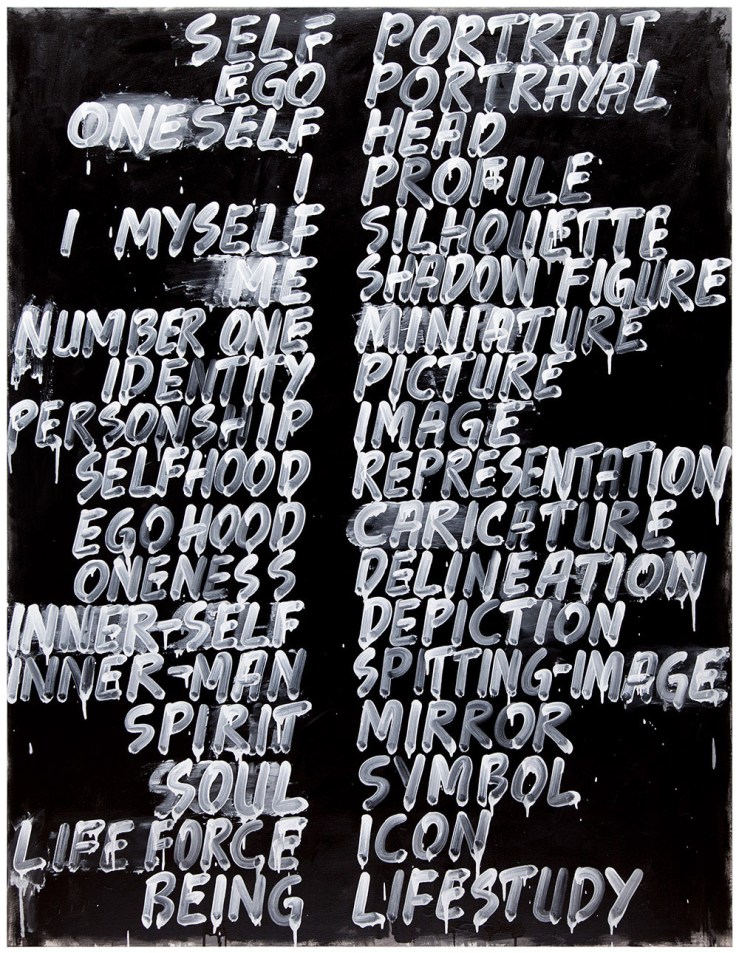
Mel Bochner’s wordy self-portrait at the Jewish Museum.

1_Self-Portrait-1000.jpg
Mel Bochner, Self/Portrait, 2013.

Also at the Jewish Museum: Repetition and Difference. Archival, contemporary, thoughtful, pretty damn brave.

7a9c5_jan29_jewishmuseum_img
Left: Amalia Pica, Stabile (with confetti) (detail), 2012. Paper and transparent adhesive tape. Courtesy the artist and MARC FOXX, Los Angeles. Photo: Robert Redemeyer, 2013. Right: Spice Containers, anonymous artist. Poland and Russia, 19th century. Silver. The Jewish Museum, New York. Gift of Harry G. Friednman, and the Rose and Benjamin Mintz Collection.

Anthony Discenza and Peter Straub‘s maddening installation about “the obscure 19-century artists’ movement known as Das Beben” at the Contemporary Jewish Museum. I read through it, paused, went back to the beginning, sat down for a bit, smiled, frowned, and then watched a few other people do the same. We all discussed, and then agreed that there is a 90% chance that Das Beben is not real. But I still don’t know. I still. Don’t. Know.


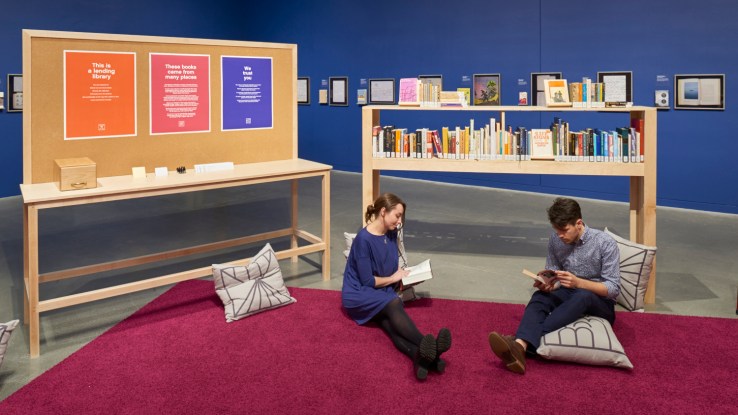
Josh Greene’s Bound to Be Held: A Book Show, also at the Contemporary Jewish Museum. (These Jewish museums, man!) So cozy. So right up my alley.

GreeneCover
Installation view of Bound to Be Held: A Book Show. Photo by Johnna Arnold.

Power and pathos at the Getty, obvs.

Victorious Athlete, “The Getty Bronze,” 300-100 B.C., bronze and copper. The J. Paul Getty Museum

Creamsicle-colored plaster surrogates at MOCA.

Allan McCollum, 60 Plaster Surrogates (No. 3), 1982-1990, enamel on hydrostone, Museum of Contemporary Art, Los Angeles

Toshio Shibata’s giant, textured photos of the built landscape at PEM a few years ago.

ts-05
Toshio Shibata, Kurioso City, Tochigi Prefecture, 1989

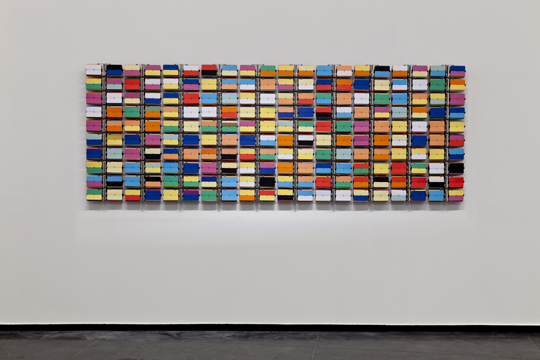
Rebecca Baumann’s colorful, emotional roller-coaster of a clock. (And the rest of Baumann’s practice, which I wrote about here.)

04.Baumann-ACF11
Rebecca Baumann, Automated Color Field (2011), 100 flip-clocks, paper, 130 x 360 x 9 cm, 24 hours. Photography: Andrew Curtis. Originally commissioned by the Australian Centre for Contemporary Art for NEW11

…AND the entire Color Fields show at the Bakalar & Paine Galleries last year. My first time touching art! Profoundly impactful. Profoundly fun.

Falcone_fullsize
Sonia Falcone, Campo de Color, 2015.

My itinerary at the Gardner: First Floor

There was a golden period of three months or so when I was training to be a volunteer at the Isabella Stewart Gardner Museum in Boston. Unfortunately/fortunately, I wasn’t able to continue on as a volunteer since I got an amazing position in the education department at the Skirball Cultural Center in Los Angeles.

Before leaving Boston, I took a few trips to the Gardner to say goodbye to some of my favorites. So here, recorded for posterity: my personal itinerary of the Gardner.

The Courtyard

2856

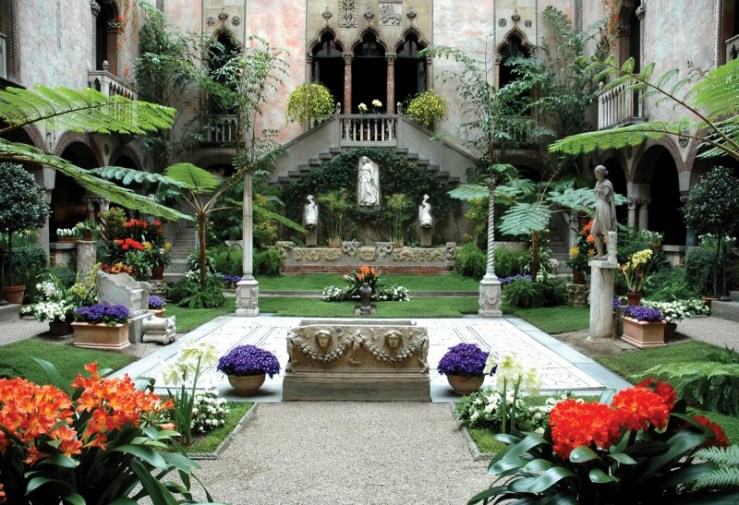
This is not the best picture of the Courtyard. It is nigh impossible to get the best picture of the Courtyard, because no picture can capture all of the hidden nooks and crannies, the soaring Palazzo walls, the giant glass roof, the steamy greenery, the shock of white marble behind orange blossoms, the nasturtiums cascading from the balconies, the quiet echo of conversation on every floor, the scratching of pencils on sketch paper, the sighs of visitors walking in and then stopping cold, the smell of old stone and fresh blooms and clover and ferns…

Anyway, this is not what you see when you first walk in. (You actually enter behind those arches on the left.) I love to stop immediately upon entering the courtyard and notice the change in light and temperature. Once I’m adjusted, I can then look around me. But only after a moment. The glass tunnel between the new wing and the historic palace is a good transition space, but it’s not quite enough. That light-dark-light thing gets me every time: the bright natural and LED light of the new wing, the dark shadows of the side entrance to the historic palace, and finally that beautiful filtered light that’s just green with vegetation and pink from the Palazzo walls and shadowy from the arcade of arches. #dead

Now that photography is allowed in the Courtyard, maybe someone will get the perfect shot.

Sargent, El Jaleo

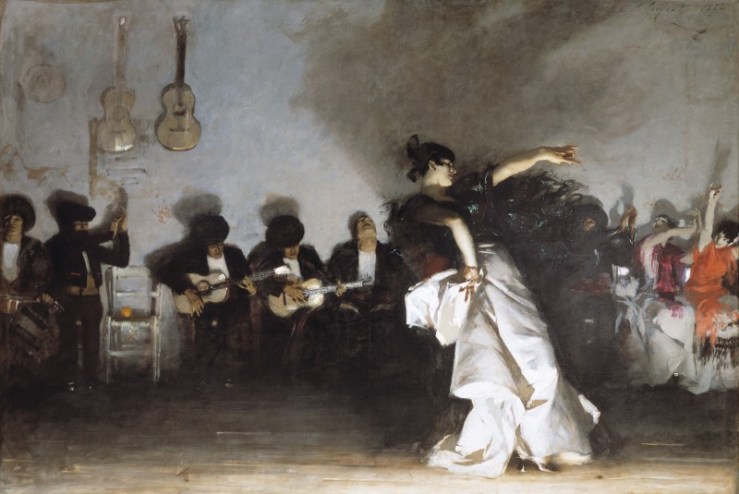
Yea, yea, everyone goes to see El Jaleo. It’s good. Legitimately good. The sense of movement, the chiaroscuro, that dude snoozing (or is he singing?), the unnatural pose of the dancer, the looming shadows. It’s good.

223
John Singer Sargent, El Jaleo, 1882

El Jaleo is huge. It’s also fitted into a nook built expressly for it, surrounded by objects chosen to highlight the colors and materials and textures, next to a mirror that reflects it and extends it. Mrs. Gardner (in her infinite wisdom) sort of stole this piece from her family member and built a whole environment around it. Basically, I go to see El Jaleo in its place. You know, it’s good. But it’s so much better in its own place.

Votive Stele

1271
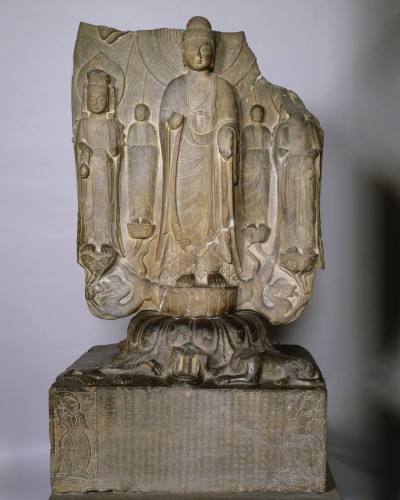
Votive Stele, Chinese (Eastern Wei dynasty)

I didn’t give this stele a second glance until I took the audio tour. I don’t remember exactly what made me stop and look closer, but oh boy, there’s a whole story going on with this serene-looking beaut. Check out the backside, featuring an assumption-ish scene from the Lotus Sutra.

Gaeta Reliefs

There is a group of four reliefs on the wall of the Courtyard right outside the Spanish Cloister, but images are not available on the Gardner’s website. (But you can find them on pp. 62-64 of Sculpture in the Isabella Stewart Gardner Museumavailable free online!) They look like the symbols of the four evangelists, except one is a deer and one is a basilisk. They are kind of mysterious in their provenance. (Maybe from the Duomo? I’m going to perpetuate that rumor.) (JK, the catalog authors are pretty sure they’re from the church of S. Lucia in Gaeta.) I like those.

Scenes of the Passion

411
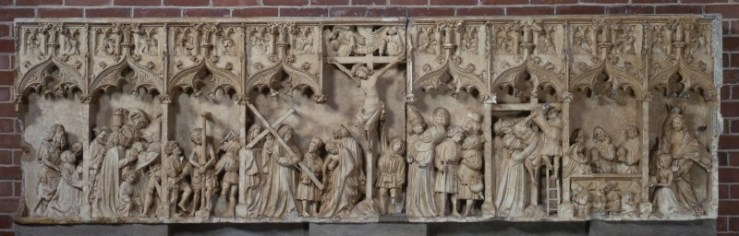
Retable: Scenes of the Passion, French, c. 1425

As a former medievalist, I can’t not stop at a Passion scene. This one, though, is all about the clothes for me: look at that drapery! The hose! The shoes! The hats!  I love to paint it in with my mind to get the full fifteenth century effect (maybe some mi-parti going on?). The whole thing looks as though it’s about to spring into rowdy, loud, technicolor action.

Roman Sarcophagus

Sarcophagus: Revelers Gathering Grapes,
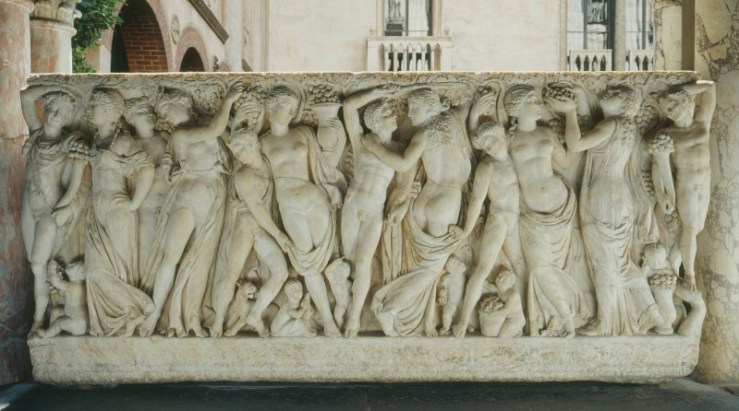
Sarcophagus: Revelers Gathering Grapes, Roman, c. 225

I didn’t quite get how important this sarcophagus was until I listened to the audio tour. (TL;DR: Do the audio tour.) It traveled from Athens to Rome in the 3rd century and lived in the Palazzo Farnese and Villa Sciarra until the 19th century, inspiring Baroque and Mannerist artists with its optic elongation and fabulous pagan imagery. As you pass from medieval architectural ornaments in the Courtyard to cinquecento paintings one flight up, it’s worth stopping to marvel at this antique treasure.

I did a nice long looking session with this sarcophagus one afternoon, and the relationships between the figures came alive. Sorting out the arms was a task in itself, and the gazes, too, are all mixed up and interconnected. It’s ridiculously expressive and dramatic and human (/demi-godish). And funny. (That guy to the right of center pulling down the maenad’s drapery: priceless.)

I tried seeing it the way Renaissance artists would see it. I didn’t even get close. But the effort in itself was rewarding.

Teaching mindfulness to kids

Reposted from the Skirball education staff blog.

What is mindfulness, anyway?

There are many different ways to define mindfulness. One of my favorite short definition comes from Mitra Manesh, mindfulness educator and founder of Rumi Rooms:

Mindfulness is nonreactive awareness and acceptance of the present moment.

Let’s break that down:

  • nonreactive: Observing what is without emotional involvement or judgement.
  • awareness:  The ability to be conscious of thoughts, emotions, and sensations without labeling, interpreting, or judging those perceptions. The power of pure observation.
  • acceptance: “Loving-kindness” or “unconditional friendliness” toward what is.
  • present moment: “Being here now” rather than rehashing the past or imagining the future.

Mindfulness is different from-but related to-Buddhist meditation. The secular practice of mindfulness is a research-based set of approaches for bringing attention to the present in order to lower stress, improve health, and increase self-awareness.  Jon Kabat-Zinn’s Mindfulness-Based Stress Reduction (MBSR) program, which he launched at the University of Massachusetts Medical School in 1979, was one of the first secular mindfulness practices to be adopted widely in the United States. Since then, thousands of studies have documented the positive impacts of mindfulness, and hundreds of programs have been launched in schools, prisons, hospitals, veterans centers, and even museums!

Let Jon Kabat-Zinn tell you more:

Mindfulness in formal education

The research has spoken: mindful awareness has a positive impact on students’ attention, executive function,  emotional regulation, pro-social dispositions, social skills, and self-compassion. There is an increasing number of programs offering mindfulness instruction to students and school-aged children.

The Inner Kids program was first taught in LA schools throughout the 2000s, and continues to be used in schools and other educational spaces. Inner Kids uses games, activities, and direct instruction to teach the New ABCs: Attention, Balance, and Compassion. A randomized controlled study of the program led by UCLA found that this program can have positive impacts on students with executive function difficulties. Inner Kids co-founder Susan Kaiser Greenland teaches parents how to cultivate mindfulness with their children in her book The Mindful Child. Annaka Harris, an Inner Kids volunteer, posted a free set of guided meditations for children that focus on “friendly wishes,” mindful hearing, and mindful breathing.

The Hawn Foundation (as in Goldie) created a program called MindUP. MindUP “teaches social and emotional learning skills that link cognitive neuroscience, positive psychology and mindful awareness training utilizing a brain centric approach.” The 15 sequenced lessons are aligned with all state standards (including Common Core!!) and support academic performance and personal growth.

Mindful Schools is a national non-profit providing curriculum training and professional development to classroom teachers and educators. To see the Mindful Schools program in action, check out the short film Healthy Habits of Mind below.

Other school-based programs include Mindfulness in Schools, CARE for Teachers at the Garrison Institute, Modern Mindfulness, and Inward Bound Mindfulness Education. Some research centers studying mindfulness and youth include the Centre for Mindfulness Research and Practice at Bangor University, the Stanford Early Life Stress Research and Pediatric Anxiety Program, the Center for Investigating Healthy Minds at University of Wisconsin, and the Greater Good Science Center at UC Berkeley.

# Ways to Teach Mindfulness to Kids: A Listicle Roundup

Here is a roundup of listicles offering some tips for teaching mindfulness to kids at home and out in the world. There are lots of variations on mindful breathing, mindful hearing, and mindful eating activities. There are some unique ones in there, too: I think my favorite is the Spiderman meditation!

Example activity: Mind Jars

Photo: Meagan Estep
Photo: Meagan Estep

Mind jars are simple tools to illustrate basic concepts in mindfulness.  The glitter in the jar represents your thoughts and emotions. When you shake the jar, you can watch your thoughts and feelings whirl around (like when you’re feeling stressed, overwhelmed, or upset). As the glitter slowly settles down, you can feel yourself calm down!

Meagan Estep, Teacher Programs Coordinator at the Phillips Collection in DC, wrote this blog post about making mind jars to open a gallery experience with families.

There are loads of instructions for making your own mind jar out there on the interwebs.

But let the kiddos themselves tell you about mind jars…

Bibliographies

Books for kids:

Books for families and educators:

Want to learn more?

The UCLA Mindful Awareness Research Center is a great resource for learning more. They teach a 6-week introductory practice class, host free meditation podcasts on their website, and guide free weekly drop-in meditations all over campus.

Direct your eye right inward, and you’ll find
A thousand regions in your mind
Yet undiscovered. Travel them, and be
Expert in home-cosmography.

-Henry David Thoreau

___

For mature readers, a meditation lolz: