From the archive

I used to blog about museum work on my academic website. Since that page has gone away, I am using this space to repost some of my favorite bits. These posts were written in 2012-13.

What is the role of “the expert” in inquiry-based, constructivist learning? | Originally posted February, 2013

I took a course with Shari Tishman at the Harvard Graduate School of Education about “Active Learning in the Museum.” In our readings and discussion, structure emerged as the key to successful learning experiences, both constructivist and inquiry-based. In his chapter on educational theory, George Hein makes this provocative statement:

“I believe that constructivism places more, not less, demands on the teacher to provide rich and rewarding environments in which learning can take place.” (page 39)

Nina Simon’s TedX talk deeply engages this question of structure; as Simon demonstrates, designed opportunities and special tools invite the audience to produce something meaningful. Ron Ritchhart’s “Cultivating a Culture of Thinking in Museums” fleshes out the forces shaping group culture, and many of these fall under the domain of the discussion facilitator (communicating expectations, allocating time, routines and structures).

The Harvard Art Museum Task Force recently took a fieldtrip to the Gardner Museum, and we asked the education staff where rigor comes from in the VTS (Visual Thinking Strategies) curriculum. Many of the strategies are echoed in Ritchhart’s article: paraphrasing, use of appropriate vocabulary, choice of object, time and repetition. So, clearly, inquiry-based learning depends on the finesse of an experienced and committed educator. What is the role of the disciplinary expert, then? On the one hand, the role of information in inquiry is critical here. My disciplinary expertise allowed me to answer a question spontaneously asked aloud by a visitor at the Getty — I provided information, and she was intellectually satisfied. I think we agree that information can be leveraged to extend inquiry; facts are not evil in themselves. On the other hand, I am interested in habits of mind and their relationship to disciplinary expertise. In many ways, the first few years of graduate school in history is a process of enculturation: we were taught, formally and informally, to think like historians. We think about authorship and reception. We are critical of claims about universality. As a premodernist, I am especially skeptical when people throw around words like “reason” and “science” and “modernity.” This is different from the content of my expertise: it’s not fact-oriented, but rather thinking-skills-oriented. Is it possible to teach disciplinary thinking dispositions in way that is consistent with inquiry-based learning? I suspect so.
1508
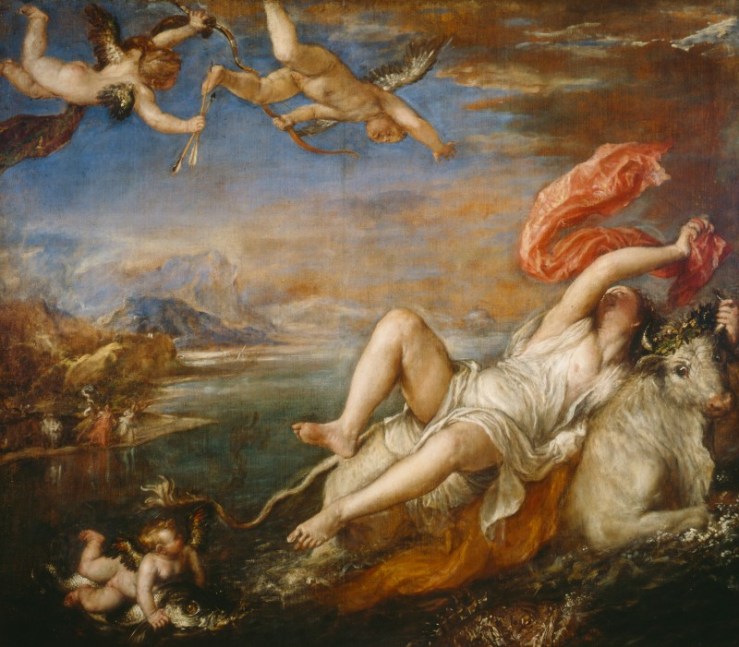
Titian. Europa, c. 1560-62. Isabella Stewart Gardner Museum, Boston, Massachusetts.

On a related note, I am getting interested in museums as sites of knowledge and sites of knowledge-production. There is a strong Foucauldian critique lurking behind this topic, of course. How do museums structure objects, space, text, and movement to create knowledge? And how self-aware are they? I suspect that exhibitions are more explicit about this than permanent installations. I would like to design a learning experience for my final project that tackles this issue, but I may be the only one in the class who is interested in this stuff. I sort of wish I were at Berkeley in the 1980s, sometimes.
From the archive

I used to blog about museum work on my academic website. Since that page has gone away, I am using this space to repost some of my favorite bits. These posts were written in 2012-13.

Curatorial Authorship and/vs. Participatory Museums: What the What? | Originally posted December, 2012

On Tuesday, members of the Harvard Art Museums’ Graduate Student Task Force (from now on, HAM GST) met with Susan Dackerman, Carl A. Weyerhaeuser Curator of Prints, to talk about her practice. She conceptualized her role in a succinct and powerful way; as a curator, her job is to figure out “what to do with the knowledge embodied by individual objects” and deploy that knowledge in museum spaces, exhibitions, and publications. Curators infer meaning from materiality. Part of Susan’s job, of course, is to mount installations and exhibitions (both she and Rob Mawry drew a sharp distinction between these two).  While a installation (often from the permanent collection) makes a statement, an exhibition is thesis-driven. That is, a curator’s task in designing an exhibition is to activate the meaning of art objects to visualize broader arguments. What’s more, Susan feels a responsibility to communicate artists’ decisions through exhibition design. Objects “work” differently in different contexts; works are active agents in the production of meaning because artists make choices. By carefully placing works in juxtaposition, Susan creates different meanings as a curator. Susan is a curatorial author, not only by choosing objects, but also by designing the spaces and textual environments in which the objects are encountered.

Museum spaces seem naturalized, but, as Susan pointed out to us, there are strategies that curators employ to make the “work” of museums invisible. The lack of awareness around curatorial authorship cuts off museum visitors from deep engagement with objects and spaces. Therefore, Susan is in the process of developing a training program to teach museum fellows how to read museum environments, how to look at them as authored spaces. This orientation toward authorship then feeds into the development exhibition-making skills; fellows will learn how to facilitate meaning-making for audiences through the lens of curatorial authorship.

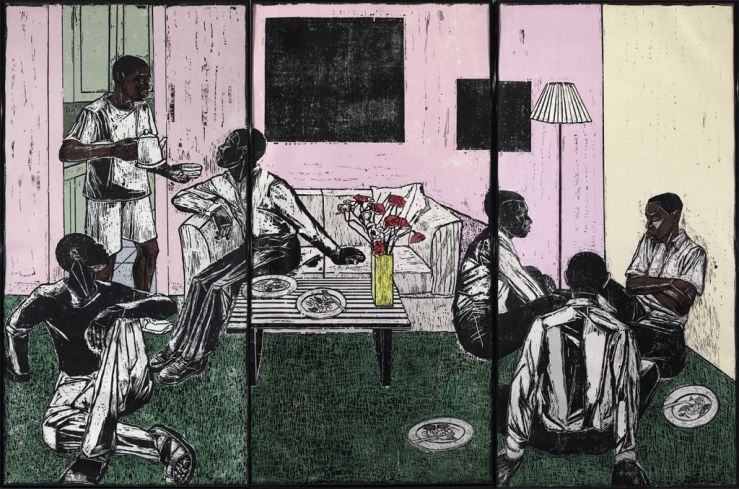
We looked at some of these choices-in-action in the Recent Acquisitions gallery of the Sackler. Susan was responsible for installing Kerry James Marshall’s Untitled, a monumental woodcut print depicting six African-American men in a quietly domestic setting reminiscent of seventeenth-century genre scenes. By interrogating Susan about her choices in front of her object in her gallery, it became really clear to us how an awareness of choice in museum spaces deepens the looking experience. Untitled is displayed on one wall (and a little bit); Susan explained how that “little bit” creates a sense of volumetric space in the piece. Corinne Zimmermann, the Senior Educator at HAM, explained how many of the installation choices “work” when she gives tours; after climbing up the stairs, viewers are confronted at first with a slice of a panoramic city scene. From the other entranceway, the central figures are framed by the doorway before visitors enter the space. Sarah Grandin, a grad student in the history of art and architecture, pointed out that the hanging of this artwork (alone in an otherwise empty gallery) was reminiscent of controversial exhibitions in the Salon. Ethan Lasser, Margaret S. Winthrop Associate Curator of American Art, interrogated Susan about the burden of interpretation: Who is responsible for making curatorial authorship visible? Should transparency be built into the design of the exhibition, or should audiences be educated enough to see through the “invisibility cloak” of curatorial practice?

Kerry James Marshall. Untitled, 1998, with 2007 additions. Harvard Art Museums/Fogg Museum, Margaret Fisher Fund. © Kerry James Marshall.

Needless to say, when I saw Nina Simon’s post about “Work In Progress” at the Santa Cruz MAH, I was immediately intrigued with this idea of transforming a space from “a museum of products to a museum of process.” Is there a difference between curatorial authorship and curatorial process? Our orientation toward audience meaning-making is different at the HAM than at the MAH; curators like Susan are interested in communicating “what I want you to learn,” while Nina Simon’s perpetual beta approach sees venues like museums as content platforms rather than content providers.

Here is my big question: If we are interested in making curatorial authorship transparent, and if active learning in art museums makes experiences “sticky” and meaningful, why not jump on the participatory museum bandwagon and let audiences do the curating? Maybe that’s not right for our university museum. It’s a good sign, however, that HAM is having these conversations. And I am so, so lucky to be a part of them.

Getting to yes

IMG_2691
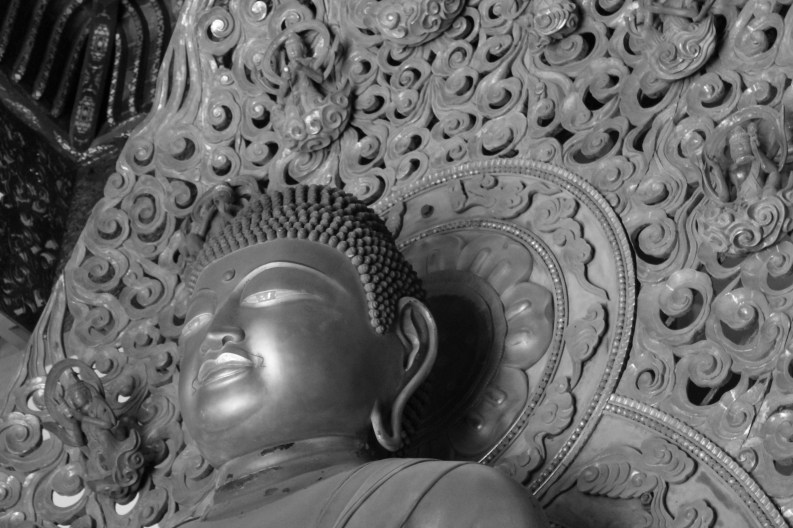
The Amida Buddha at the Byodo-In Temple, Valley of the Temples Memorial Park, Kahaluu, O’ahu, Hawaii

What I learned by half-listening to a Lunch with NEMA session on “Zen and the Art of Negotiation” with Dan Yaeger:

  • Enlightened negotiation builds relationships
  • Keep an ear out for people’s egos (the word “respect” is a buzzword)
  • Focus on interests (what matters), not positions (how you label yourself)
  • Use objective criteria
  • Invent options for mutual gains
  • Consciously determine the Best Alternative to a Negotiated Agreement
  • Ask “What would you do if you were in my position?”
  • Be still & silent. Like the Buddha. It will freak out your negotiation partner and will make him talk more. (I like this one!)
  • Be optimistic and come to the table from a place of abundance
  • Something about manly quiche. And orange peels. And pies. And fresh strawberries.

Bottom line: I’m really bad at focusing on lecture-based webinars. Especially when I’m in PJs at home. Hrmph.

On taste & salt

In my new job, I am asked to have taste.

This is unusual for me. As a history grad student, I was asked to use critical thinking. And skepticism. And cleverness. There was a certain aesthetic sense of absence when a story was half told or evidence was missing or an argument didn’t hold up. There is a texture to good history; Dan Smail (my former advisor) has it, Peter Brown has it, Lester Little has it, Caroline Walker Bynum has it in spades. A cadence, a rhythm, a satisfying gotcha or a piquant description of something one usually passes over. Good history is pleasing to read and useful to think with. How can one not develop a sense of taste for good history, after reading (well, skimming) hundreds of books and articles to pass generals? (To me, it felt like chugging fondue.) I suspect that my colleagues who are around the world working in archives are building that intuitive, aesthetic sense for good primary sources, too. Something rich, something beautifully formed that “fits” into a story just so. Some ideas are just more useful than others. Some prose is just more beautiful than others. Some ways of thinking, some expressions are stickier. [Of course the reception depends on the reader’s life story, the time of day, what one ate for lunch…(oy, I can’t help defending myself against some metaphysical such and such argument…actually, I just heard Howard Gardner speak about Beauty – capital B – the other day…another post…)].

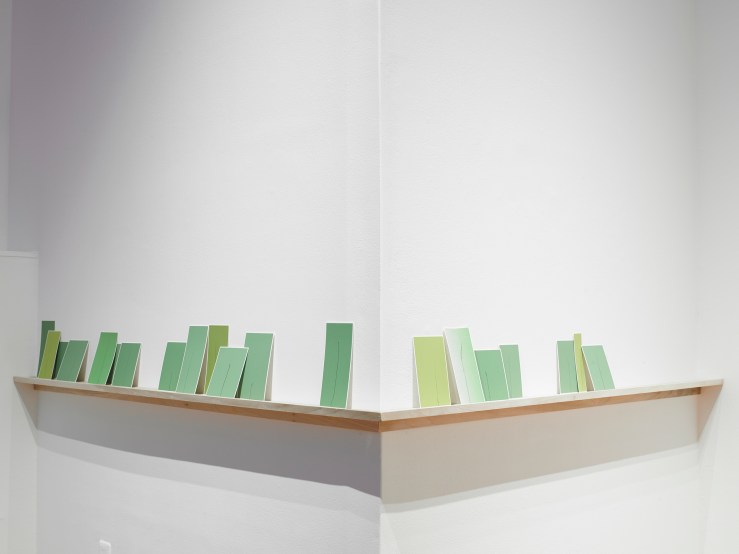
Sonia Falcone, Campo de Color ("Color Field") (2012/15). Installation view, photo by Zachary Allen.
Sonia Falcone, Campo de Color (“Color Field”) (2012/15). Installation view, photo by Zachary Allen.

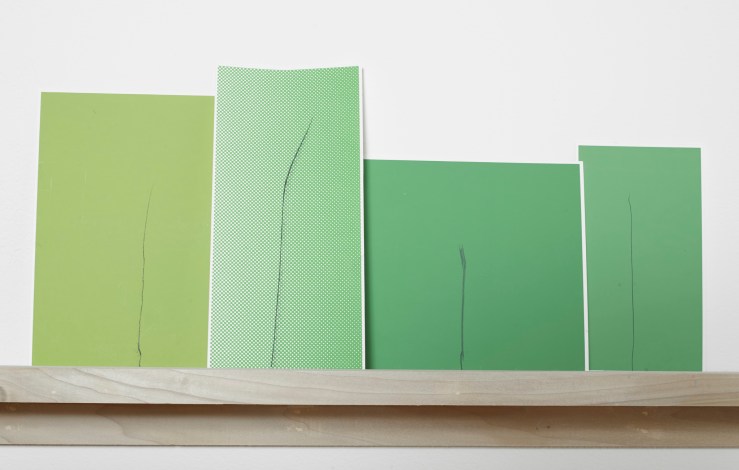
Anyway, I now find myself in a position where i have to use honest to God taste in my job. An actual sense of visual aesthetics. Like, which green panel should go where? Is that canvas warmer or cooler than that one, and should it go between these two or those two? Not only do I have to identify visual differences (which is harder for me than for an artist or art history student, someone used to looking), but I also have to use distinction and discrimination when arranging those visual objects. I arrange and swap and mould (piles of salt and pigment) and rearrange until things look good.

Kate Shepherd, Disputing a Notion, Green Grasses (2000-14). Installation view, photo by Zachary Allen.

I do not trust my eye (yet). I have severe Imposter Syndrome. For the first time, however, this is not crippling for me. (I used to freeze up and then melt down when waves of doubt hit.) This is actually pretty stimulating. I have built a (so far short) museum career on telling other people that they can look at art, that they do have something interesting to say, that their personal responses matter. In some ways, this job is putting my most basic values about art under the microscope. Here is what I have been thinking to myself while “curatorial assisting” during this exhibition’s installation:

My response to this piece matters! But not really, because there is an art historical, canonical interpretation of what this should look like and what it should mean, and if you do not know the context of this work’s production or the reference it is making, you are dumb and uncultured. Well, no, because there is not a lot of research about this yet. It is a contemporary piece. Look, the artist is over there! Yea, but anyone who is anyone with taste will know that that should not look like that. But I like it! Why? Because it makes me feel all the things this way, and it does not the other way. But still. Do your research. You have a lot to catch up on.

Kate Shepherd, Disputing a Notion, Green Grasses (2000-14). Installation view, photo by Zachary Allen.

My inner critic is right – I do need to do the research. I do need to develop my eye. I do need to build up a foundation, an arsenal in order to be a better, more sophisticated looker. 


In Move CloserJohn Armstrong recounts some stories from John Ruskin’s autobiography, when the artist would spend hours in his own London neighborhood delighting in the ordinary. Ruskin also wrote of his favorite painter Turner noticing dusty sunbeams and cabbage leaves and oranges in wheelbarrows in a dark alley-way off of Covent Garden. Writes Armstrong:

Experience of special, privileged objects is not, then, the needful thing; what counts is that the experiences are delighted in, dwelt upon, mobilized and made use of. What we need is ‘to take an interest in the world of Covent Garden’ – or whatever bit of the world it is we encounter – ‘and put to use such spectacles of life as it affords.’ It is from such experiences that deep engagement with works of art emerges. (page 37)

I sometimes wish that I had more visual acuity as a child – fewer books, more looking around. Or, that I had taken a greater interest in art-making after my short (yet triumphant!) turn as an AP Studio Art student. Or, that I had taken intro to art history in college after all. Or, or, or…

I guess I now have to be the child I wish I had been. I just have to go out there and do it. Notice the cabbages and all that.

NB: I am familiar with, but not fluent in, Bourdieu. So…I dunno. If the above sounds naive, it is. It is full of class things and gender things, too, I suppose. Maybe we’ll dig into those some day.