In other words, don’t spend too much time worrying about someone else’s intellectual theories when, to put it bluntly, nobody ever understood anything less by looking a little longer. (page 163)
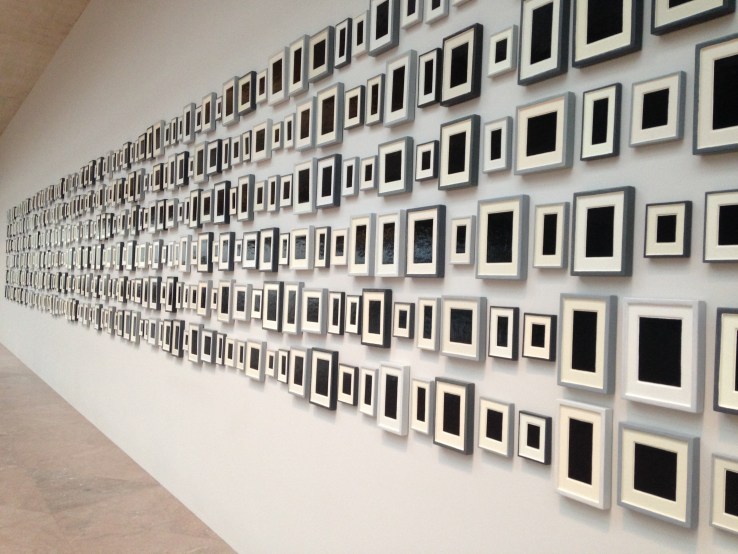
Allan McCollum, “Surrogate Paintings” & “Plaster Surrogates”
I had the privilege of seeing Allan McCollum in conversation with art historian Miwon Kwonat the Hammer last year in conjunction with the exhibition Take It or Leave It: Institution, Image, Ideology. I think McCollum’s work is just so generous, so human, so democratic, so unpretentious. He doesn’t fetishize his objects. He works with communities and gives to them, freely. And in his conversation with Miwon Kwon, he totally resisted theorizing his own work, which was awesome.
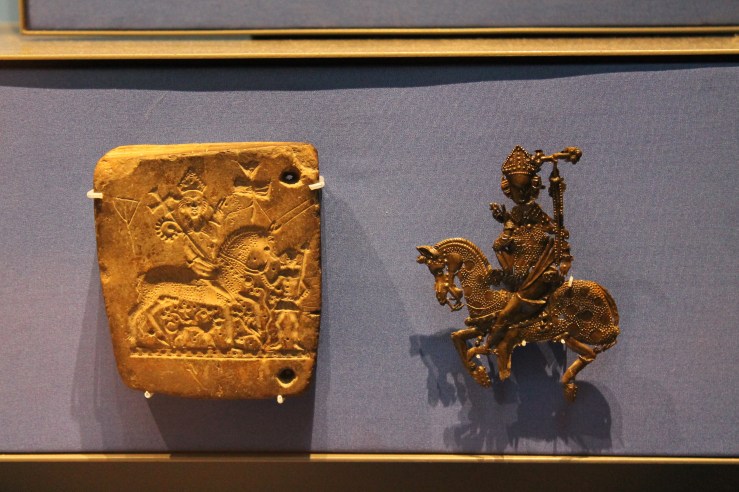
As someone who was obsessed with medieval technologies of reproduction (pilgrim badges, specifically), I laughed out loud when I first encountered his work in Take It or Leave It.
Pilgrim badge with Thomas Becket returning from exile. Installation view with mold at the British Museum.
He has complicated my thinking about mass production and unique objects more than any other thinker or writer (pace Walter Benjamin). And he’s so nice, to boot!
So excited to see ’em again at the National Gallery! December, 2014.
What this exercise shows students is that just because you have looked at something doesn’t mean that you have seen it. Just because something is available instantly to vision does not mean that it is available instantly to consciousness. Or, in slightly more general terms: access is not synonymous with learning. What turns access into learning is time and strategic patience.
Seeing for oneself, which imagination and reverie encourage, is not merely convenient (there isn’t always a helpful guide to hand). Seeing something for oneself helps to make the experience matter personally. From an austerely rational point of view, the difference in genesis (seeing for yourself or having something pointed out by another) ought not to make any difference. After all don’t you end up with the same perception? But we know perfectly well that in many areas of existence personal discoveries have a savour and intimacy which is rarely matched by what we learn from others. Even though we need others to point out some things, it is a loss if they don’t leave room for our own discoveries. The value of personal discovery lies in the fact that not only do we arrive at a helpful conclusion, but that we have experience of how the conclusion was reached. We gain acquaintance with the process of coming to see. (page 78)


 mindful museums