
There was a golden period of three months or so when I was training to be a volunteer at the Isabella Stewart Gardner Museum in Boston. Unfortunately/fortunately, I wasn’t able to continue on as a volunteer since I got an amazing position in the education department at the Skirball Cultural Center in Los Angeles.
Before leaving Boston, I took a few trips to the Gardner to say goodbye to some of my favorites. So here, recorded for posterity: my personal itinerary of the Gardner.
The Courtyard
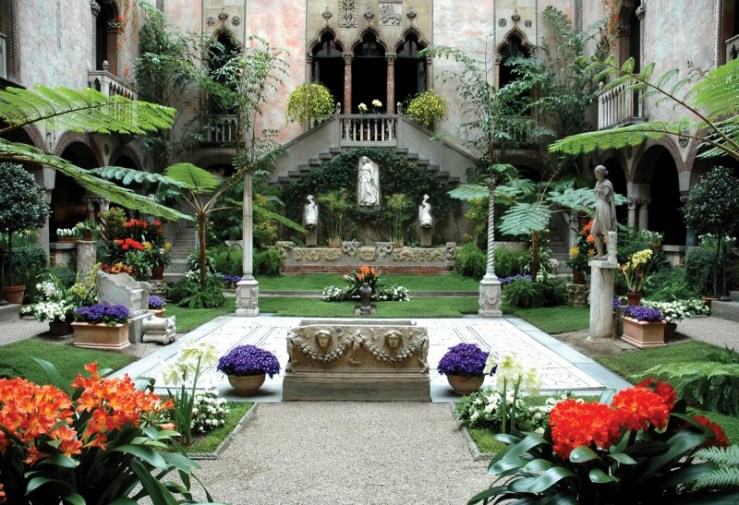
This is not the best picture of the Courtyard. It is nigh impossible to get the best picture of the Courtyard, because no picture can capture all of the hidden nooks and crannies, the soaring Palazzo walls, the giant glass roof, the steamy greenery, the shock of white marble behind orange blossoms, the nasturtiums cascading from the balconies, the quiet echo of conversation on every floor, the scratching of pencils on sketch paper, the sighs of visitors walking in and then stopping cold, the smell of old stone and fresh blooms and clover and ferns…
Anyway, this is not what you see when you first walk in. (You actually enter behind those arches on the left.) I love to stop immediately upon entering the courtyard and notice the change in light and temperature. Once I’m adjusted, I can then look around me. But only after a moment. The glass tunnel between the new wing and the historic palace is a good transition space, but it’s not quite enough. That light-dark-light thing gets me every time: the bright natural and LED light of the new wing, the dark shadows of the side entrance to the historic palace, and finally that beautiful filtered light that’s just green with vegetation and pink from the Palazzo walls and shadowy from the arcade of arches. #dead
Now that photography is allowed in the Courtyard, maybe someone will get the perfect shot.
Sargent, El Jaleo
Yea, yea, everyone goes to see El Jaleo. It’s good. Legitimately good. The sense of movement, the chiaroscuro, that dude snoozing (or is he singing?), the unnatural pose of the dancer, the looming shadows. It’s good.
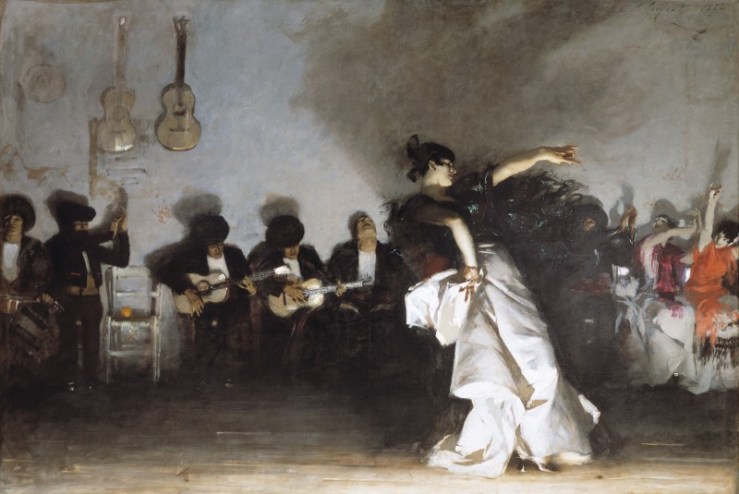
El Jaleo is huge. It’s also fitted into a nook built expressly for it, surrounded by objects chosen to highlight the colors and materials and textures, next to a mirror that reflects it and extends it. Mrs. Gardner (in her infinite wisdom) sort of stole this piece from her family member and built a whole environment around it. Basically, I go to see El Jaleo in its place. You know, it’s good. But it’s so much better in its own place.
Votive Stele
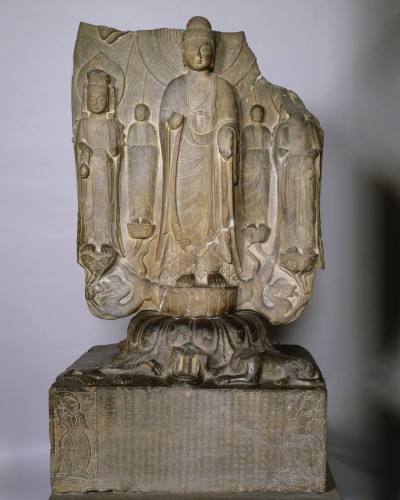
I didn’t give this stele a second glance until I took the audio tour. I don’t remember exactly what made me stop and look closer, but oh boy, there’s a whole story going on with this serene-looking beaut. Check out the backside, featuring an assumption-ish scene from the Lotus Sutra.
Gaeta Reliefs
There is a group of four reliefs on the wall of the Courtyard right outside the Spanish Cloister, but images are not available on the Gardner’s website. (But you can find them on pp. 62-64 of Sculpture in the Isabella Stewart Gardner Museum, available free online!) They look like the symbols of the four evangelists, except one is a deer and one is a basilisk. They are kind of mysterious in their provenance. (Maybe from the Duomo? I’m going to perpetuate that rumor.) (JK, the catalog authors are pretty sure they’re from the church of S. Lucia in Gaeta.) I like those.
Scenes of the Passion
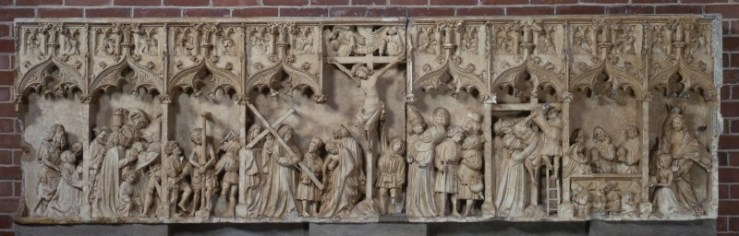
As a former medievalist, I can’t not stop at a Passion scene. This one, though, is all about the clothes for me: look at that drapery! The hose! The shoes! The hats! I love to paint it in with my mind to get the full fifteenth century effect (maybe some mi-parti going on?). The whole thing looks as though it’s about to spring into rowdy, loud, technicolor action.
Roman Sarcophagus
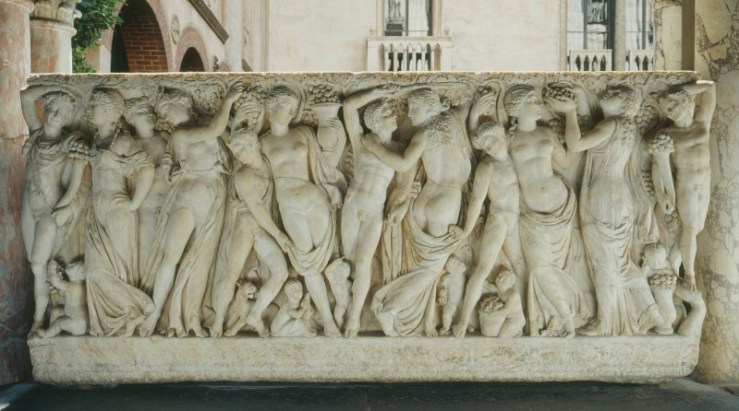
I didn’t quite get how important this sarcophagus was until I listened to the audio tour. (TL;DR: Do the audio tour.) It traveled from Athens to Rome in the 3rd century and lived in the Palazzo Farnese and Villa Sciarra until the 19th century, inspiring Baroque and Mannerist artists with its optic elongation and fabulous pagan imagery. As you pass from medieval architectural ornaments in the Courtyard to cinquecento paintings one flight up, it’s worth stopping to marvel at this antique treasure.
I did a nice long looking session with this sarcophagus one afternoon, and the relationships between the figures came alive. Sorting out the arms was a task in itself, and the gazes, too, are all mixed up and interconnected. It’s ridiculously expressive and dramatic and human (/demi-godish). And funny. (That guy to the right of center pulling down the maenad’s drapery: priceless.)
I tried seeing it the way Renaissance artists would see it. I didn’t even get close. But the effort in itself was rewarding.
 mindful museums
Hi!
I read your description regarding Gaeta reliefs.
I live in Gaeta and are interested in this particular sculpture. Could you tell me if these four panels (two Evangelists and two symbolic figures) are the currently-displayed at the Museum of Isabella Stewart Gardner?
Can you tell me a site or a way to find the latest photos of this sculpture?
I inform you that the remainder of these reliefs were relocated at the Basilica Cathedral of Gaeta (https://www.facebook.com/1624186141131334/photos/a.1624187294464552.1073741828.1624186141131334/1624187371131211/?type=3&theater ).
Waiting for some his courteous reply, I wish you a good day.
Roberto Di Domenico
LikeLike